Exam questions that actually test thinking
ScholarBee maps every question to a Bloom's level you choose — Remembering up to Creating — so your assessments measure what your syllabus actually promises.
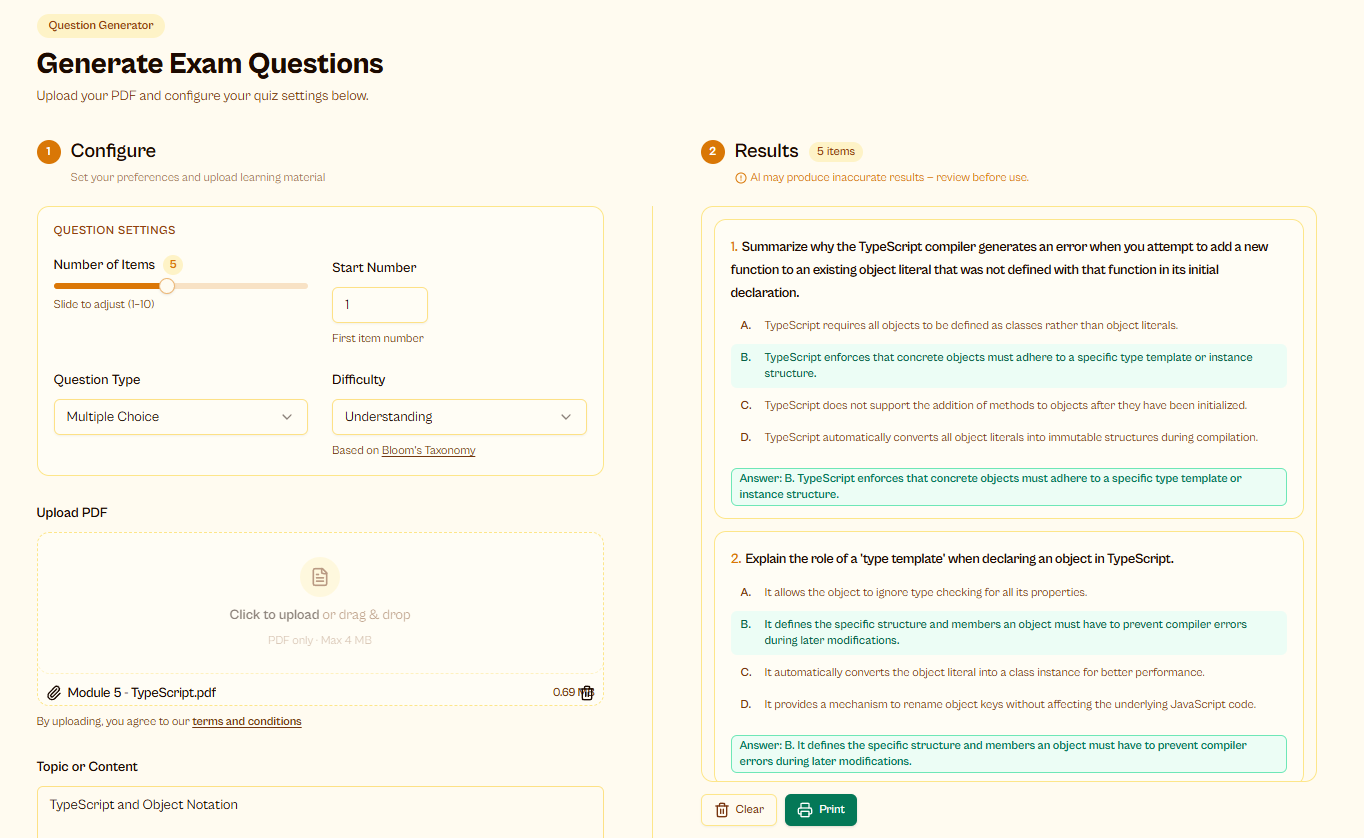
From PDF to Exam in Seconds
No setup. No prompt engineering. Just upload, configure, and generate.
Upload Your PDF
Upload any PDF content — lecture notes, textbooks, syllabus readings — up to 4 MB.
Set Your Cognitive Level
Choose a Bloom's Taxonomy level — from Remembering to Creating — along with question type and count.
Generate & Export
Get structured questions with answers instantly. Print for class, share as in-app practice, or both.
Why Questions From ScholarBee Are Different
Questions That Test Understanding
ScholarBee maps every question to one of Bloom's six cognitive levels — from Remembering to Creating. You get assessments aligned to your learning outcomes, not random trivia.
Grounded in Your Material
Your uploaded PDF is the source of truth. Every question is anchored to your specific content — your lecture notes, textbooks, or syllabus readings — not generic AI output.
Build a Reusable Question Bank
Save your generated question sets and revisit them whenever you need. Pull from your bank next semester, or share a set with your class so they can practice in-app.
Three Types. One Tool.
Generate the exact format your exam needs — all from the same PDF upload.
Which process is primarily responsible for producing ATP during cellular respiration?
A. Photosynthesis B. Glycolysis ✓ C. Transpiration D. Osmosis
The Treaty of Versailles, signed in 1919, formally ended World War I.
The atomic number of an element is equal to the number of ______ in its nucleus.
Got Questions?
What is Bloom's Taxonomy and why does it matter?
Bloom's Taxonomy is a six-level framework for categorizing learning objectives — from basic recall (Remembering) up to original thinking (Creating). ScholarBee uses it to ensure every generated question tests understanding at the right cognitive depth, not just surface-level memorization. This is what separates ScholarBee from generic AI question generators.
Is ScholarBee free to use?
Yes — ScholarBee has a free plan. Sign up and get 10 generations a month at no cost. A Pro plan with higher limits is coming soon.
Can I save my generated questions?
Yes. After generating a question set, you can save it to your account and revisit it anytime from your library. Build a reusable question bank for next semester, and share saved sets with your class for in-app practice.
Is my PDF stored or shared?
Your PDF is used only to generate questions during your session. It is not stored on our servers or shared with anyone. Your uploaded material stays yours.
What file types are supported?
Currently, ScholarBee supports PDF files up to 4 MB. Support for more file types is on our roadmap.
How accurate are the generated questions?
ScholarBee uses advanced AI to generate questions grounded in your uploaded material. Results are high quality — but always review before using in a class or exam.
Can I control difficulty level?
Yes. ScholarBee maps difficulty to Bloom's Taxonomy — choose from Remembering, Understanding, Applying, Analyzing, Evaluating, or Creating.
Does ScholarBee support outcomes-based assessment (OBE)?
Yes. Every question is mapped to a Bloom's Taxonomy cognitive level you choose, which makes it straightforward to align items with your course's learning outcomes — the foundation of OBE-style assessment.
Can students use ScholarBee too?
Yes. When you save a question set, students can take it as a practice quiz inside ScholarBee — instant scoring, immediate feedback. They get exam-style practice without you needing to print or set up anything else.
Stop writing exams from scratch.
Generate Bloom's-aligned exam questions from your own lecture material — in under a minute. Free to start.
Free · No credit card required · Grounded in Bloom's Taxonomy research